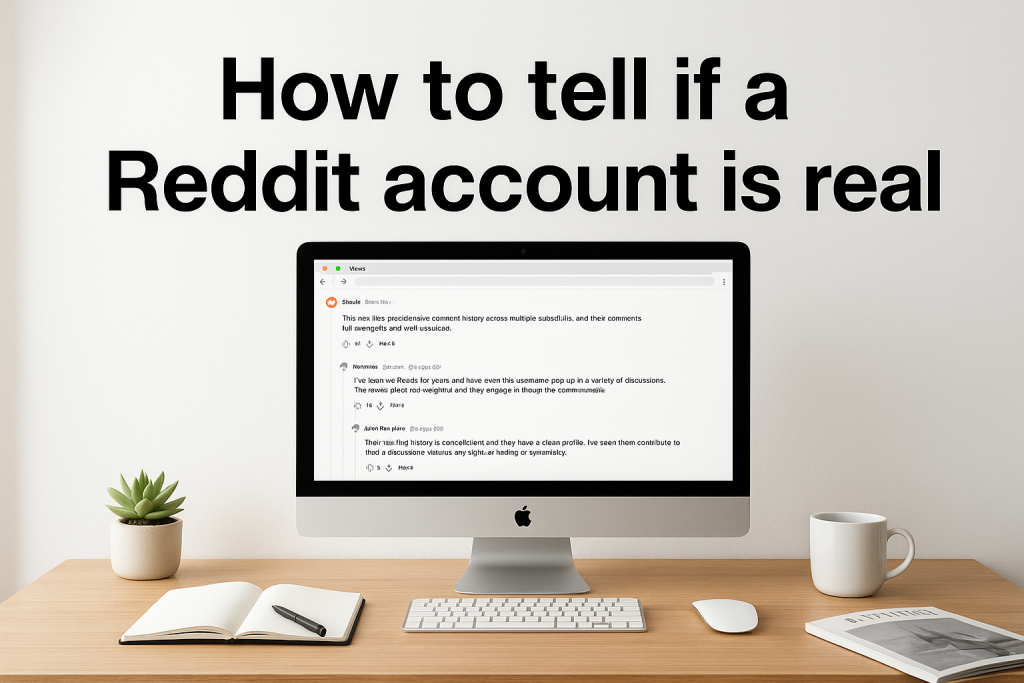
When I size up a Reddit account, I move fast at first; age, karma breakdown, posting habits, comment quality, then slow down for deeper signals like cross-post patterns and external links. Start with the creation date and whether the user writes with context and specifics. Most automated accounts struggle with varied, context-aware replies or with referencing unique, verifiable facts. No single signal is decisive, so stack independent markers: a mixed comment history, plausible posting times, consistent usernames or linked profiles, and original photos or verifiable external accounts. If those align, odds are you’re looking at a real person. If multiple red flags cluster, treat the account with caution—especially when money or safety is on the line—and escalate as needed.
Key Takeaways
- Blend quick visible checks (age, karma, recent posts) with behavioral signals (timing, cross-posts) before deciding.
- Diverse, context-rich comments and consistent external profiles are strong positive signals.
- Scan for identical posts or repeated URLs across subreddits to catch coordination or automation.
- When money or safety is involved, document evidence and use escrow or report to mods/admins.
Why verifying a Reddit account matters and a fast triage checklist
Most of us don’t have all day to vet an account before replying, buying, or sharing anything personal. Verifying a Reddit account reduces scams, misinformation, and moderation churn. Quick checks won’t catch subtle operators, but they’ll block a surprising number of obvious scams.
Quick triage checklist (5 to 10 seconds)
Open the profile. Note the creation date, total karma, and the last screenful of posts/comments. Scan for botty tells: identical posts blasted across multiple subs, a wall of link-only comments, or a throwaway username full of random characters. None of these prove anything on their own, but they tell you where to dig next.
Why a fast check helps
Sometimes you have seconds before you click a link or fire off a reply. That 10-second look saves you from most “obvious if you looked” traps. People lean too hard on flair or profile pictures; both are easy to fake wherever they’re allowed.
Example: aged account with sudden cross-posting
I audited a four-year-old account that dropped the same crypto referral across r/CryptoCurrency, r/BitcoinBeginners, r/Economics, and several small finance subs within a single day. The age and scattered history looked good—until the 24-hour burst of identical copy gave away coordination. Context matters, of course; r/technology and r/news see legit cross-posts, but the pattern and timing were off here.
Manual signals you can read on a profile
Manual inspection won’t scale to thousands of users, but it’s your best filter to separate obvious fakes from plausible humans. Mix signals rather than fixate on any single metric.
Account age
Creation date is visible on every profile. Older accounts are usually more trustworthy because long-term believable behavior is costly to fake. But age isn’t proof. Sockpuppets get “parked” for months or years, then brought back when a campaign needs them.
Karma distribution and what it reveals
Look at post and comment karma across subreddits. Real users tend to touch a handful of topics. A big karma pile concentrated in a tiny subreddit or a single viral spike is a yellow flag. Also ask: did karma accrete as a slow drizzle over time, or in one weird jump that smells like manipulation?
Posting patterns and content variety
Humans meander. Real comments ask follow-ups, share small anecdotes, and reference previous threads. Bots lean on templates, generic encouragement, or weirdly off-topic replies. Length doesn’t equal authenticity—some scripts write paragraphs without saying anything new.
Comment quality and context matching
Trust rises when a comment cites verifiable detail. A DIY reply with a specific part number (e.g., “Shimano B01S pads”) or a timestamped photo is more credible than a generic “Looks great!” Moderators are good at catching tiny inconsistencies that casual readers sail past.
Example: three accounts with 10k karma
I compared three 10k-karma accounts. One posted steady r/nyc and r/AskNYC tips with street-level photos and specific cross-street details. Another scored 9k from one viral r/memes post and had thin history elsewhere. The third sprayed quick off-topic one-liners and link-drops in r/technology and r/Entrepreneur. The first read like a person. The latter two looked like part of attention-gathering or promo work.
Behavioral signals: timing, frequency, and network patterns
Text alone can be misleading. Timing, cadence, and who an account interacts with surface patterns you won’t catch on a cursory read.
Posting frequency and cadence
Humans are lumpy posters. Bots often run at tidy intervals or push too much volume. Rigid hourly cadence is a red flag. That said, community managers sometimes schedule posts, and night-shift workers do exist—context matters.
Timezone consistency and active hours
Skim timestamps across a few days. Real users usually post during plausible waking hours for their region. Accounts pumping content steadily around the clock deserve a second look. Global teams and scheduled cross-posting can explain it, so don’t jump to conclusions.
Cross-posting and same-content footprints
Duplicated text or URLs across multiple subs in short windows usually indicates a script or playbook. Tracked URLs, shortened links, and repeated UTM tags (e.g., utm_source=reddit across several posts) are classic tells. Reused hosts or identical query strings also give away a campaign.
Network behavior and shared interactions
When an account regularly replies to or gets upvoted by the same tight cluster, you might be looking at coordination. Network tools can map this. Tight friend groups or small hobby subs naturally cluster too, so be conservative with calls.
Example: coordinated promo vs real user
I watched two accounts post carbon-copy copy at 02:00 UTC into r/startups, r/marketing, and r/smallbusiness, while a third spent afternoons in r/woodworking sharing step-by-step builds with original workshop photos. The first two screamed coordination. The third behaved like a person with sawdust on their hoodie.
Profile signals: usernames, bios, linked accounts, and avatars
These are easy to fake, but patterns still leak through. Taken together with behavior, they’re useful.
Username patterns
Handles packed with random letters or long numeric tails are common in automated batches. A handle tied to a known public persona, used consistently across platforms, carries more weight. Sophisticated operators pick plausible names too—so treat usernames as weak evidence on their own.
About, bios, and external links
Links to a personal site or established social accounts are strong signals. Click through. Do those accounts show real activity and consistent identity? Lots of scammers link to thin blogs that look legit until you scratch the surface.
Avatars and image checks
Run a reverse image search. Stolen avatars are common. Flairs are not proof of anything—mods and scammers both use them. I once flagged a “local business owner” whose avatar turned out to be a Shutterstock model. That was all the doubt we needed to pause their promo.
Linked accounts across platforms
Consistency across Twitter, GitHub, LinkedIn, or a personal site is a high-quality positive signal. If someone claims to run a company but links to an empty LinkedIn, slow down. Privacy-minded users may avoid linking anything at all, so weigh other signals.
Example: aged accounts used for outreach
Brands sometimes buy aged accounts to skip the warm-up period. I’ve seen agencies use them to launch campaigns on day one, which raises ethical and policy questions. For a deeper look at account aging trade-offs, see this account age comparison. I don’t endorse buying accounts; I’m telling you it happens.
How to separate bots, sockpuppets, and real users
These buckets overlap. I sort first by automation, then by intent.
Identifying bots
Bots post based on scripts or triggers. Look for repetitive phrasing, copy timing that lines up to exact intervals, and keyword-triggered replies. API timestamps often show rhythmic periodicity. Some useful bots disclose themselves in bios and are welcome in certain subs.
Spotting sockpuppets
Sockpuppets exist to boost or shield a primary. Few posts, lots of interaction with the main account, and a tendency to upvote or defend it. They’re often spun up for a short run and then abandoned—classic mod headache.
Signals of a real person
Real people show rough edges: minor typos, shifting tone, original photos, “thinking out loud” in threads. They stick around for back-and-forths. Heavy posting isn’t disqualifying—some power users are simply very online.
Example: nuanced replies vs link-only accounts
I reviewed one account that posted nuanced takes on r/PersonalFinance with detailed spreadsheets and payoff screenshots over months; another dumped the same fintech link and “Thoughts?” in five subs. The first read human. The second was clearly script-assisted outreach.
Tools and data sources that make verification practical
Reddit’s UI gets you the basics. External tools reveal patterns your eyes will miss on a quick scroll.
Reddit site and API for basics
Start with the profile. For deeper checks, use the Reddit API to pull submissions and comments. Respect rate limits. Remember: deleted or removed items won’t reliably show up via the API.
Pushshift for historical reconstruction
Pushshift stores historical Reddit data and is great for bulk queries and locating deleted posts. It often exposes cross-post footprints that are invisible in the live UI. Indexing can lag and coverage varies by community.
Browser extensions and moderator tools
Extensions like Reddit Enhancement Suite help surface subreddit breakdowns and comment karma by community—handy for spotting one-topic accounts. Mods lean on these, but always cross-check the raw permalinks and timestamps before acting.
Network and cluster analysis tools
Mapping replies and shared links exposes suspicious groups. The learning curve is real, but coordinated campaigns pop out once you graph them.
Example: simple API script that finds repeated links
I wrote a short script to pull the last 500 comments via the API, hash URLs and common n-grams, and flag repeated phrases and identical links. It shrank a haystack of thousands into a small pile worth a human look.
Tool walkthroughs and repeatable queries
When you’re busy, you want procedures you can run over and over. Here are ones I’ve used in real cases.
Pulling a user’s timeline with the API
Register an app, get credentials, and hit endpoints like /user/{username}/submitted and /user/{username}/comments. Export timestamps and text. Look for identical posts, tight timing, and unusual cadences. The API won’t always include removed or deleted content.
Using Pushshift to find deleted content and cross-posts
Query Pushshift by author and time window. Compare link hashes to spot duplicates across subs. Promotional posts often persist in Pushshift after they disappear on Reddit.
Browser checks with Reddit Enhancement Suite
RES can show subreddit breakdowns and comment karma by subreddit—useful for sockpuppet detection. RES also surfaces moderator-only details where applicable. Always confirm with direct permalinks.
Example search queries
Search exact phrases in quotes to catch copy-paste. Search URL hosts (and UTM tags like utm_campaign) to reveal campaign footprints. Limit by date ranges to see bursts. Beware false positives—niche subs often share the same reputable resources.
Annotated case studies and sample investigations
Abstract rules get messy in the wild. These anonymized cases mirror what mods and analysts actually face.
Seller listing that looked too good
A 1-month-old account posted a high-end GPU in r/hardwareswap at a price too sweet by half. Profile history existed only in that sub and linked to a barely used Instagram. Reverse image search matched the photos to a listing in a different city from two months earlier. We flagged it; the post was removed.
Coordinated promotional cluster
Several accounts posted identical copy with the same UTM-tagged URL in r/technology, r/startups, and r/ProductManagement within minutes. Network analysis showed they upvoted each other in quick succession. Mods quarantined the posts; Reddit admins opened an investigation.
The believable newcomer
A two-month-old account wrote detailed, photo-backed comments in r/analog about film stocks and dev times (e.g., HP5+ in HC-110 Dilution B, 6.5 minutes). Low karma, steady contributions. I treated it as genuine and would still insist on escrow for any sale.
Lessons from investigations
Context is king. I score signals and only escalate when multiple strong indicators align. Acting on one weak trait—like “low karma”—creates false positives and burns goodwill.
Verifying public figures and moderators
High-profile accounts deserve extra caution. Public figures often verify elsewhere, and moderators have visible UI signals that you can confirm.
Cross-platform verification
Look for links from official pages, verified Twitter/X, or a personal site to the Reddit handle. A journalist who posts “I’ll be answering Qs at u/HandleHere” from a verified account is strong evidence.
Moderator indicators and mod logs
Moderators show a shield in the subreddit UI, and their actions appear in mod logs. If someone claims mod status in DMs, check the public mod list. Serious matters usually go through modmail, not private chats.
Example: confirming a local politician
I matched a Reddit AMA announcement to a post on the official city website and a tweet from a verified account linking to the same AMA thread. The cross-check made the ID conclusive.
Investigating accounts before transactions and marketplace safety
Never skip verification when goods or money are involved. A long DM thread and friendly tone do not equal proof.
Transaction checklist
Check age, search for trade history in community feedback threads, ask for timestamped photos, and use a trusted escrow for higher-value deals. I once walked away because the buyer’s account was three days old and they insisted on Zelle with no escrow. Easiest decision of the week.
Marketplace red flags
Refusing verified payment methods, pushing to move off-platform (WhatsApp/Telegram) fast, or inconsistent stories—these are common tells. Some collectors prefer off-platform deals; that’s their choice, but it demands extra verification and a higher risk tolerance.
Template for pre-transaction checks
Ask for the profile link, a recent timestamped image (paper note with today’s date and username in frame), evidence of past trades (e.g., r/hardwareswap rep threads), and willingness to use neutral escrow. If any piece falls apart, walk away.
Reporting, escalation, and what to include
Vague reports sink into queues. Clear, reproducible evidence gets actioned.
What to include when you report
Username, profile permalink, links to the content in question, timestamps, and any message copies. Add pattern evidence—identical posts, tight time windows, matching URLs. Screenshots or a CSV help moderators move faster.
When to contact moderators versus admins
Moderators handle subreddit rule violations. Reddit admins handle platform-wide abuse: doxxing, threats, coordinated manipulation. If you suspect criminal activity, preserve evidence and involve law enforcement.
Example: reporting a vote-manipulation ring
I sent mods and admins a CSV with timestamps, permalinks, and a short summary. Mods removed the posts, and admins opened an audit. The reproducibility mattered more than the length of the report.
Privacy, ethics, and legal limits when investigating accounts
There’s a line between verification and intrusion. Don’t cross it.
Privacy boundaries
Stick to public information. Reverse image searches and public cross-platform checks are fine. Don’t publish private messages or try to deanonymize beyond what’s publicly available.
Legal considerations
Never impersonate moderators or officials. If you’re collecting evidence for legal reasons, preserve timestamps and chain of custody. For threats or illegal activity, contact law enforcement and coordinate with admins.
Example: handling harassment reports
A community member shared harassment screenshots. I documented the public posts, pointed them to the official reporting flow, and avoided running a private investigation. That protected privacy and stayed on the right side of policy.
Limitations, false positives, and avoiding overinterpretation
No single test proves authenticity. False positives happen when rules are applied without context.
Why false positives happen
New genuine users, community managers, and enthusiastic hobbyists can mirror “bad” patterns. A CM cross-posting scheduled announcements can look like a bot. Nuance, always.
How to reduce false positives
Combine multiple independent signals—age, diverse comments, external verification, and consistent behavior. If several agree, treat the account as likely real. Avoid acting on one weak negative like “short username.”
Example: scheduled cross-posts mistaken for bots
I once flagged a “bot,” then found a linked blog detailing scheduled cross-posts by a lone human admin. I updated my workflow to check linked profiles before escalating. Saved me some embarrassment.
Practical checklist and a copyable report template
Consistency beats cleverness when you’re busy. I use a short checklist and a compact report.
10-point verification checklist
1) Account age and creation date. 2) Karma breakdown by subreddit. 3) Last 50 posts and comments for repetition. 4) Timestamps and timezone patterns. 5) Cross-post footprint and identical URLs. 6) External links and reverse image search. 7) Interaction cluster analysis. 8) Moderator or public figure verification if relevant. 9) Transactional history for marketplace accounts. 10) Notes and recommendation.
Copyable reporting template
Username: [u/username]. Profile link: [permalink]. Summary: [two-sentence summary of concern]. Evidence: [permalinks, timestamps, CSV or exported data]. Recommendation: [remove posts, suspend account, escalate to admins]. Include direct permalinks so mods can act quickly.
Example of a filled template
Username: u/exampleSeller. Profile: /user/exampleSeller. Summary: New account posting identical product listings in five cities. Evidence: permalinks to each post with timestamps and screenshots. Recommendation: remove listings, verify photos, ban if fraud confirmed.
Tools, scripts, and advanced tactics for analysts
For power users and moderators, light automation helps you scale without losing nuance.
Python script outline
Use PRAW or the Reddit API to fetch submissions and comments. Export text and timestamps, compute a repeat ratio for identical content, and measure inter-post intervals. I’ve used a repeat-ratio threshold around 0.6 to flag accounts for manual review (tune for your community).
Batch checks with Pushshift
Use Pushshift to surface deleted content and cross-post history. Query by author and filter by link domain to reveal campaign footprints.
Visualization and cluster detection
Export interactions and build a graph where users are nodes and replies/upvotes are edges. Dense cliques stand out. Community size and natural cliquishness affect what “dense” means—set thresholds empirically.
Comparing new accounts and aged accounts
There are trade-offs when choosing between new and aged accounts for outreach or marketplace use. Here’s a practical comparison.
| Feature | New Reddit Account | Aged Reddit Account |
|---|---|---|
| Trust signal | Low initially, needs time to build | Higher because of visible history and karma |
| Risk of immediate bans | Higher due to spam filters and posting limits | Lower; past behavior can avoid automated throttles |
| Suitability for promotions | Poor for immediate outreach | Better for launching campaigns without long warm-up |
| Ethics and compliance | Safe when built legitimately | Depends on how the account was acquired and used |
| Practical cost | Time investment | Monetary or procurement cost |
I’ve seen companies buy aged accounts to skip trust hurdles. If that’s under consideration, read the rules of each subreddit and weigh the ethics carefully. For context on anonymity and account use, see this resource on anonymity on Reddit. Your reputation is hard to rebuild once you burn it.
Frequently asked questions
Quick answers to what people usually ask after the basics.
How can I tell if a Reddit account is a bot?
Look for clockwork posting intervals, repetitive phrasing, and identical links across multiple subreddits. Bots often lack personal details. Check API timestamps for strict periodicity. Some legitimate services post automatically and say so in their bios—read those first.
Can karma be faked or bought?
Karma can be manipulated via vote rings and coordinated campaigns, and it can grow legitimately too. Treat raw karma as a starting point, not proof. Inspect where the karma came from and the nature of the contributions.
What signs point to a sockpuppet?
Sockpuppets mostly interact with a primary account, rarely contribute elsewhere, and often upvote or defend that main account. Network analysis can reveal clusters, though it’s not always conclusive.
Are reverse image searches useful?
Yes. They catch stolen avatars and reused product images. They’re strongest when the timeline or location doesn’t match. Not every image is unique, so pair this with other signals.
How do I report a suspicious account to Reddit?
Send mods/admins a clear summary, permalinks, timestamps, and pattern evidence when reporting to moderators or admins. One shaky post is weak; a set of examples with consistent timing and content gets traction.
When should I involve law enforcement?
Contact law enforcement for threats, extortion, doxxing, or confirmed financial fraud. Preserve timestamps, messages, and any related files. Mods and admins can help, but serious crimes belong with the police.
Troubleshooting common corner cases
Edge cases demand patience. Here’s what’s worked for me.
High karma from one viral post
Open the viral post and check the sub. If 80–90% of karma comes from a single r/pics or r/memes banger, be cautious. Look for steady, topic-relevant contributions before you trust the account for anything transactional.
Accounts with deleted histories
Deleted content can hide patterns. Use Pushshift and cached pages to reconstruct. Deletion isn’t guilt—some users purge for privacy or job searches. Judge in context.
Inconsistent language or tone
Style shifts can mean multiple operators, but bilingual users and people toggling between r/AskDocs and r/NBA naturally change tone. Look for corroborating signals before you decide.
Moderator impersonation attempts
Verify against the public mod list. If someone claims mod powers in PMs, check publicly and ask them to use modmail. Impersonation is common. Official issues rarely start in DMs.
Advanced considerations for researchers and moderators
At scale, you need automation that still leaves room for human judgment.
Designing a score-based system
Weight signals like age, repeat-ratio, link diversity, and cluster density. Score accounts and route those over a threshold to manual review. Tune weights using known benign and malicious examples from your community.
Sharing evidence responsibly
Share sanitized exports—omit private data. Provide permalinks, timestamps, and behavior summaries rather than raw messages that could expose victims or private info.
Moderator workflows that scale
Set daily triage windows, save common spam searches, and keep a living doc of signals and handling steps. It cuts decision fatigue and keeps the team consistent.
Where platform documentation and research help
Leverage official docs and academic work; you don’t have to reinvent the wheel.
Reddit documentation and moderator resources
Reddit’s help pages cover policies, reporting, and mod tools. Citing policy in reports and appeals clarifies what you’re asking for.
Academic research on bots and manipulation
Papers like Varol et al. describe features used in detection—posting intervals, duplication rates, and more. Blend these with platform-specific context and your accuracy improves.
Example: training volunteers
When I trained a volunteer mod team, we paired Reddit mod docs for process with Varol-style features for triage. Detection rates went up; false positives went down. Boring but effective.
Final guidance
You can tell if a Reddit account is real by mixing quick visual checks with behavioral analysis and cross-platform verification. No single signal proves authenticity, so combine independent markers and document your findings. Start with the 10-point checklist, add a small script or Pushshift query if you need scale, and keep context front and center before you act.
If you want a dead-simple next step: export the last 200 comments and run a duplicate-text check. You’ll catch basic automation in minutes.